
Ortawater: From Anthropocene artifacts to new philosophical materialisms
reading time
8 minutes
Abstract (claude sonnet 4.5)
Este ensayo explora Crímenes del Futuro (2022) de David Cronenberg como dispositivo de reflexión sobre la función performativa del cine en la reconfiguración de la percepción colectiva. A partir del concepto benjaminiano de «inconsciente óptico» y la teoría de la reproductibilidad técnica, se propone el término «neo-órganos» para designar aquellos dispositivos perceptuales que el aparato cinematográfico inserta en el espectador, reorganizando visceralmente la economía del deseo. La película de Cronenberg —situada en un futuro donde el cuerpo humano muta espontáneamente y el dolor ha desaparecido— se lee no como representación distópica sino como operación quirúrgica sobre el presente: el cine como cirugía estética y política que normaliza la mutación corporal al convertirla en espectáculo. En diálogo con Freud (pulsión de muerte), Foucault (inversión del panóptico) y Deleuze-Guattari (cuerpo sin órganos), el texto interroga cómo las narrativas audiovisuales administran lo real en su capacidad de producción masiva, instalando los órganos perceptuales necesarios para metabolizar el Antropoceno como condición estética normalizada.
Keywords
Anthropocene, Vibrant matter, Response-ability, Situated knowledges, Assemblage, Artwork, New ecologies
content
Criticism question: In what way has the technical artefact introduced a paradigm of hybridisation into mediation as a founding factor in understanding a post-humanist system and entering into the realm of new materialism (J. Bennett) for anthropocenic ecologies.
Case study (Artwork): «Ortawater-Portable» by Lucy and Jorge Orta
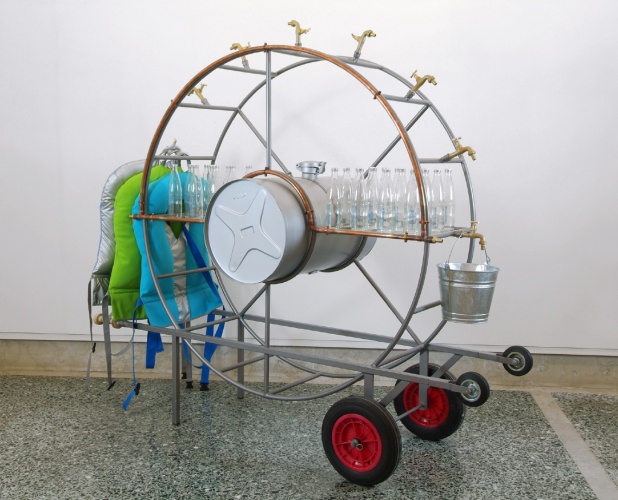
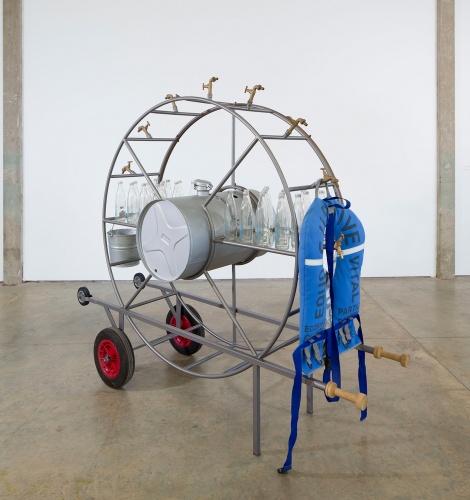
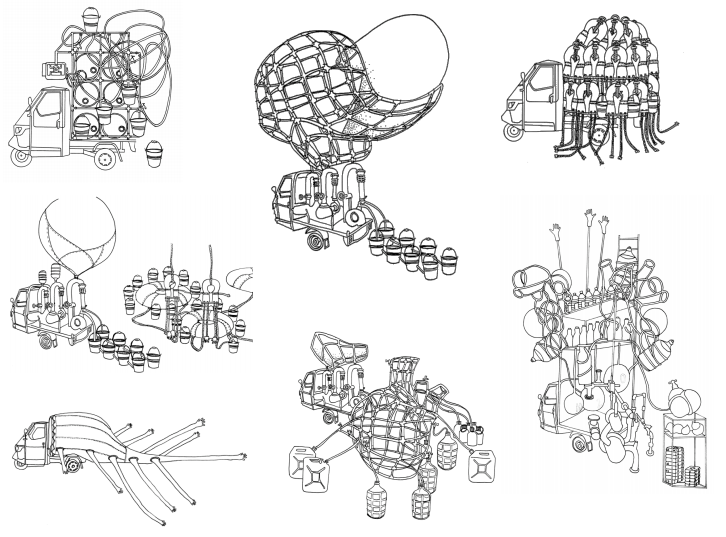
For a narrative understanding of the concept of the Anthropocene and design, the fundamental starting point lies in the dismantling of the modern paradigm: the sovereignty of the human subject over other forms of intelligence, which serves to instrumentalise everything under the rationalist intellect that governs, with dominant enlightenment, the unfolding of other forms of the world. This modernist perspective sweeps aside planetary limits in the face of the empire of the human, and thus everything must be arranged for appropriation in the face of the passivity of an environment (ecosystems) that offers itself up for the construction of the pyramid that will sustain the cities and centres of consumption under its dominion.
However, this overstimulated intellectual apparatus not only constructed a fictional scenario of power, but also made the artefact mediate every interaction with the planet, creating a reality of dependency between the living subject and its means of survival.
This dependence and vital fragility form the focus of Orta Studio’s work, as they explore the aesthetics of ‘response-for-survival’ within an ontological framework where vitality is mediated by the artefactual – no longer merely for utility, but as interdependent for coordination with non-living agents – and thus, in the Anthropocene, the assemblage with other forms of non-human intelligence constitutes the only possible roadmap for ensuring conditions for life on the planet.
By assembling industrial components for domestic use (such as ladders, glass, water filters, hoses and dollies, amongst others), the artists present a non-living ‘organism’ for water purification. In other words, they assert that the bridge between life and dehydration hinges on artifice. This assembly not only highlights the vulnerability of humanity in the face of the historical complexities involved in accessing water within communities, but in this vital exercise the boundaries between subject and object dissolve, for Ortawater-Portable is an “Anthropocene hybrid” that operates as part of the complete framework of survival, challenging us to adopt a perspective where the artificial exerts agency over the human, within a new interdependent scenario for negotiating living conditions.
This political materialism extends the agency of the non-living, no longer as a resource, but as the Heideggerian useful (‘das Zeug’), capable of reshaping the entire landscape in the face of the extractivist crisis, scarcity, and access to natural ‘resources’ as vital as water; this aesthetic exercise demands a form of development in which the arts and design serve as the terrain for constructing post-capitalist strategies.
From Ortawater to new distributive policies of the matter
In its formal dimension, Ortawater relieves domestic objects of their symbolic burden as structures for industry and reimagines them as agents of human connection. It invites reflection on new contexts for the design object, from which to shape not only ways of life, but also political systems for technology and, consequently, for the consolidation of new ecological materialisms.
Ultimately, the interplay between the non-living, political models and the shift from ideological frameworks towards planes of radical subsistence lies at the heart of Ortawater’s proposal, challenging the vulnerability and the tenuous vitality of the species brought about by five hundred years of extractive industrialisation.
This work invites us to take a fresh look at human systems, our understanding of the land, and the history of thought as a whole, shifting the focus towards new areas of relationship and shared responsibility—not only with regard to the impact of human activity on the geological landscape, but above all to the frameworks governing the interplay between design and the consequences of user-centred design, addressing towards relational models of co-dependence with other non-human intelligences and, in doing so, to rethinking scenarios of hybridisation with other expressions of nature, as well as materialities, leading to the establishment of new object-based interfaces for learning and, in this development, to the reconstruction of a cultural context in which design drives infrastructures for life, adaptation and the regeneration of life on the planet.